
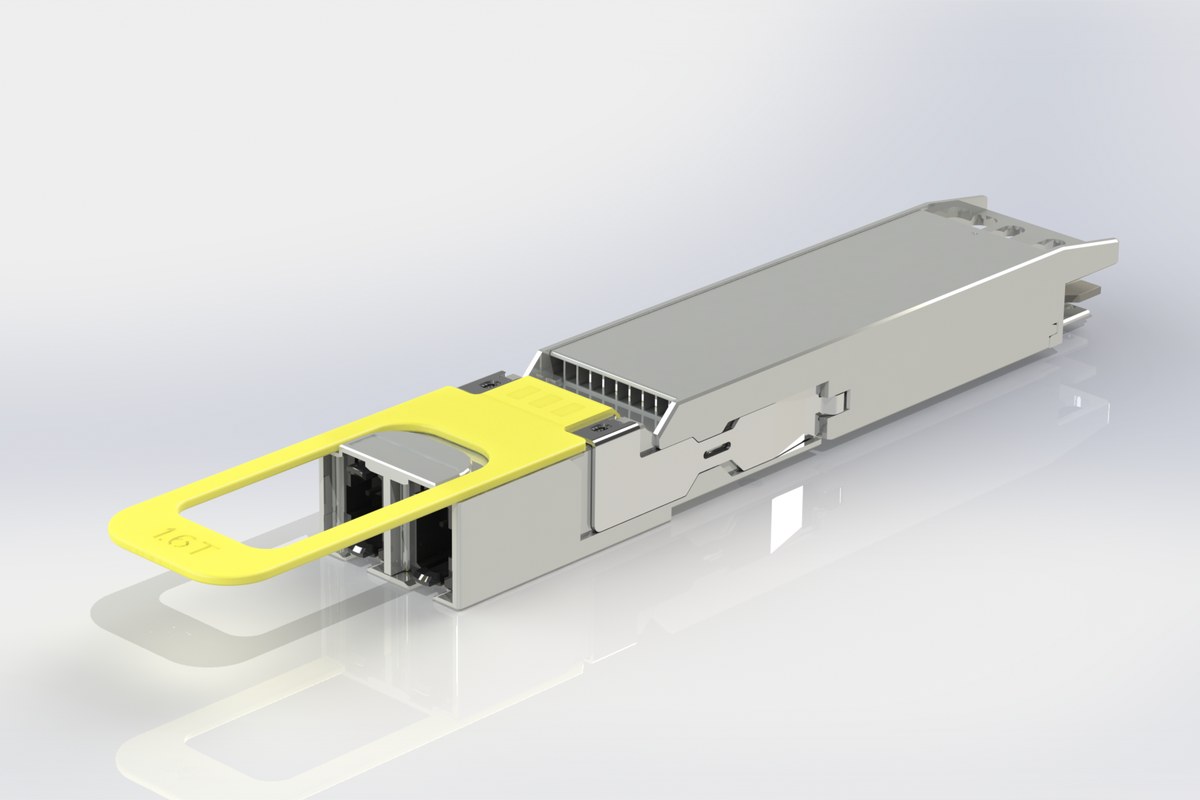
The jump from 800G to 1.6T does not change the OSFP form factor, it just packs far more power and signaling into it. Module designers are now budgeting north of 30 W per port inside a cage that still has to hot-swap into a live system without disturbing its neighbors. That puts two analog problems front and center: inrush control and high-speed-line ESD.
Hot-swap without the glitch
At 1.6T power levels, plugging a module into a powered line card draws an inrush spike that can sag the rail for every other port on the card. An on-module eFuse with programmable current limit and controlled dV/dt ramps the supply in cleanly, then stays in circuit as the always-on overcurrent and overvoltage guard.
ESD that does not cost bandwidth
The electrical interface and the management sideband both need ESD protection, but 1.6T lanes cannot tolerate the capacitance a generic diode adds. Ultra-low-capacitance TVS arrays, well under a picofarad per line, protect the high-speed pairs without rounding off the edges, while a separate array handles the slower control bus.
Magnias is sampling both functions in packages sized for the cramped OSFP paddle card. Talk to your FAE about a reference protection layout for your 1.6T design.